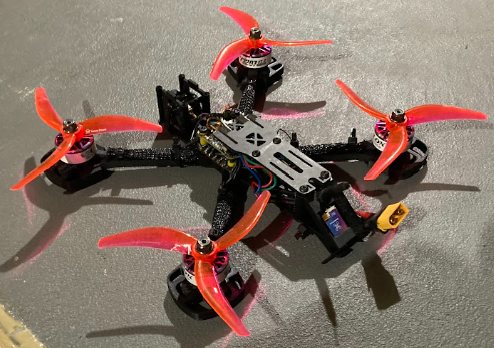
Overview
I assembled, programmed, and successfully flight-tested a drone using a complete set of components provided by my PLTW Aerospace Engineering class. The project provided hands-on experience with aircraft assembly, component integration, troubleshooting, programming, and flight testing. Despite having limited assembly instruction, my team and I independently researched and integrated the systems to produce a fully operational drone.
Drone Construction
My team received the necessary components and materials for the project, but limited assembly instruction was provided. I independently researched the assembly process through instructional videos and troubleshooting to determine how the components should be integrated.
This experience strengthened my ability to learn unfamiliar systems, follow technical information, and solve problems independently.
Components
The drone incorporated several advanced systems and materials, including:
- GPS tracking
- FPV camera
- Carbon fiber frame
- Brushless motors
Programming
In addition to assembling the physical components, my team programmed the flight controller to configure the drone’s operating parameters and enable effective control of its systems.
We integrated both an FPV headset and a remote controller, allowing the pilot to view the camera feed while controlling the aircraft.
Testing
After completing the assembly and programming, we conducted flight testing to evaluate the drone’s operation and verify that the integrated systems functioned as intended. Testing provided an opportunity to identify and troubleshoot issues with the aircraft’s components and control systems.
During a subsequent crash, several wires became tangled in the propellers and disconnected. This provided a practical lesson in wiring management, component protection, and the importance of inspecting an aircraft after an incident before returning it to operation.